Saturday, February 21, 2009
Display problem ? Click HERE

As the price of electricity, natural gas and other fossil fuels continues to climb, chemical processors are more closely examining high-temperature operations and heat-transfer systems to see if more efficiency can be had. In many cases
it can, and, as a result, heat-transfer projects are not only justifiable, but downright attractive.
There was a dialog among a few heat exchanger specialist from Alfa Laval, Paul Muller, Exergy LLC, etc. The dialog mainly discussed on strategy to improve heat transfer efficiency, heat recovery and efficient process control during this high energy price arena.
A few tips have been present :
- The energy crisis results high prices all of the time shorten paybacks. Energy efficient is one of the way to minimize cost
- Energy efficient heat transfer equipment such as Plate Heat exchanger, Gasketed Heat exchanger, Bonded Heat exchanger, etc is one of the option.
- For a service using Shell & Tube (S&T), the overall heat transfer coefficient (HTC) is around 300 Btu/h ft2°F. However, the overall heat transfer coefficient (HTC) for a compact heat exchanger can be improved 3-4 times (~1000 to 12000 Btu/h ft2°F).
- With higher overall heat transfer coefficient, this may translate into less space, smaller installation and handling cost.
- Gasketed Heat exchanger good for maintenance. However shall take additional attention on the compatibility between gasket and fluid.
- All welded or Bonded heat exchanger may be considered if there is gasket & fluid compatible problem
- For laminar flow, heat transfer rate is only the function of fluid thermal conductivity. Operate heat transfer equipment at laminar flow during turndown could significantly reduce it heat transfer rate
- Compact heat exchanger promote turbulence. High turbulence increase heat transfer rate and reduce fouling
- Thus plant releasing hot exhaust gas from burner, boiler, gas turbine, etc to atmosphere may take the opportunity to recover heat
- Improve temperature control in process system would reduce energy usage
Not a CE subscriber... click here to subscribe FREE Chemical Engineering (CE)
Related Topic
- Cooling Water Fouling Factors
- Wire Matrix Turbulator Improve Heat Transfer in ACHE
- Control Valve at Inlet or Outlet of HEX ?
- Tantalum S&T HEX vs Carbon Block HEX...
- Control Around Heat Exchanger
Labels: Heat Exchanger, Heat Recovery


Wednesday, August 20, 2008
Display problem ? Click HERE
As the price of electricity, natural gas and other fossil fuels continues to climb, chemical processors are more closely examining high-temperature operations and heat-transfer systems to see if more efficiency can be had. In many cases
it can, and, as a result, heat-transfer projects are not only justifiable, but downright attractive.
There was a dialog among a few heat exchanger specialist from Alfa Laval, Paul Muller, Exergy LLC, etc. The dialog mainly discussed on strategy to improve heat transfer efficiency, heat recovery and efficient process control during this high energy price arena.
A few tips have been present :
- The energy crisis results high prices all of the time shorten paybacks. Energy efficient is one of the way to minimize cost
- Energy efficient heat transfer equipment such as Plate Heat exchanger, Gasketed Heat exchanger, Bonded Heat exchanger, etc is one of the option.
- For a service using Shell & Tube (S&T), the overall heat transfer coefficient (HTC) is around 300 Btu/h ft2°F. However, the overall heat transfer coefficient (HTC) for a compact heat exchanger can be improved 3-4 times (~1000 to 12000 Btu/h ft2°F).
- With lower overall heat transfer coefficient, this may translate into less space, smaller installation and handling cost. Capital cost may not be low as the fabrication cost for compact heat exchanger is high.
- Gasketed Heat exchanger good for maintenance. However shall take additional attention on the compatibility between gasket and fluid.
- All welded or Bonded heat exchanger may be considered if there is gasket & fluid compatible problem
- For laminar flow, heat transfer rate is only the function of fluid thermal conductivity. Operate heat transfer equipment at lamina flow during turndown could significantly reduce it heat transfer rate
- Compact heat exchanger promote turbulence. High turbulence increase heat transfer rate and reduce fouling (read more)
- Thus plant releasing hot exhaust gas from burner, boiler, gas turbine, etc to atmosphere may take the opportunity to recover heat
- Improve temperature control in process system would reduce energy usage
Not a CE subscriber... click here to subscribe FREE Chemical Engineering (CE)
Related Topics
- Self Cleaning Heat Exchanger - Online Cleaning ?
- Unexpected High Cost of Heat Exchanger Fouling...
- Heat Exchanger Fouling Mechanism, Prevention and Treatment...
- Why Lower Fouling factor in Plate Heat Exchanger ?
- Practical Design Tips for Heat Exchanger
- What type of heat exchanger can be used to handle fluid with solid ?
Labels: Heat Exchanger, Heat Recovery, Plate Heat Exchanger
Monday, October 1, 2007
Can't view properly ? Click HERE
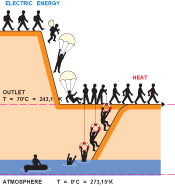 Chemical & Process plant is energy intensive industry. However, so far waste energy in the form of heat, noise, vibration, etc is dissipated to environment without or with some level of recovery. Example of heat recovery is the waste heat recovery unit (WHRU) located at the Gas turbine flue gas outlet, economizer at the boiler flue gas outlet, etc. Generally the flue gas exit temperature still rather high i.e. 250 degC, as compare to ambient temperature of 30 degC, believe there is still heat can be recovered from temperature perspective. But how much energy can be recovered and it this worth for recovery ? How to measure quantity of heat recovered to generate work ?
Exergy is the term to measure the capability of a hot fluid to produce work.
Above article has described a simplified approach to evaluate the exergy content of a hot waste and estimate amount of useful energy can be recovered from waste gases.
Related Topics
Chemical & Process plant is energy intensive industry. However, so far waste energy in the form of heat, noise, vibration, etc is dissipated to environment without or with some level of recovery. Example of heat recovery is the waste heat recovery unit (WHRU) located at the Gas turbine flue gas outlet, economizer at the boiler flue gas outlet, etc. Generally the flue gas exit temperature still rather high i.e. 250 degC, as compare to ambient temperature of 30 degC, believe there is still heat can be recovered from temperature perspective. But how much energy can be recovered and it this worth for recovery ? How to measure quantity of heat recovered to generate work ?Exergy is the term to measure the capability of a hot fluid to produce work.
Raynald Labrecque & Kiari Goni Boulama
Above article has described a simplified approach to evaluate the exergy content of a hot waste and estimate amount of useful energy can be recovered from waste gases.
Related Topics
Labels: Exergy, Heat Recovery, Heat Transfer