Saturday, February 21, 2009
Display problem ? Click HERE

As the price of electricity, natural gas and other fossil fuels continues to climb, chemical processors are more closely examining high-temperature operations and heat-transfer systems to see if more efficiency can be had. In many cases
it can, and, as a result, heat-transfer projects are not only justifiable, but downright attractive.
There was a dialog among a few heat exchanger specialist from Alfa Laval, Paul Muller, Exergy LLC, etc. The dialog mainly discussed on strategy to improve heat transfer efficiency, heat recovery and efficient process control during this high energy price arena.
A few tips have been present :
- The energy crisis results high prices all of the time shorten paybacks. Energy efficient is one of the way to minimize cost
- Energy efficient heat transfer equipment such as Plate Heat exchanger, Gasketed Heat exchanger, Bonded Heat exchanger, etc is one of the option.
- For a service using Shell & Tube (S&T), the overall heat transfer coefficient (HTC) is around 300 Btu/h ft2°F. However, the overall heat transfer coefficient (HTC) for a compact heat exchanger can be improved 3-4 times (~1000 to 12000 Btu/h ft2°F).
- With higher overall heat transfer coefficient, this may translate into less space, smaller installation and handling cost.
- Gasketed Heat exchanger good for maintenance. However shall take additional attention on the compatibility between gasket and fluid.
- All welded or Bonded heat exchanger may be considered if there is gasket & fluid compatible problem
- For laminar flow, heat transfer rate is only the function of fluid thermal conductivity. Operate heat transfer equipment at laminar flow during turndown could significantly reduce it heat transfer rate
- Compact heat exchanger promote turbulence. High turbulence increase heat transfer rate and reduce fouling
- Thus plant releasing hot exhaust gas from burner, boiler, gas turbine, etc to atmosphere may take the opportunity to recover heat
- Improve temperature control in process system would reduce energy usage
Not a CE subscriber... click here to subscribe FREE Chemical Engineering (CE)
Related Topic
- Cooling Water Fouling Factors
- Wire Matrix Turbulator Improve Heat Transfer in ACHE
- Control Valve at Inlet or Outlet of HEX ?
- Tantalum S&T HEX vs Carbon Block HEX...
- Control Around Heat Exchanger
Labels: Heat Exchanger, Heat Recovery


Wednesday, February 18, 2009
Display problem ? Click HERE
Recommended :
Tubular Exchanger Manufacturers Association (TEMA) has developed a series of fouling factor for Shell and Tube (S&T). These fouling factor are generally higher than Plate Heat Exchanger (PHE), why not use S&T fouling factors to size PHE ?
Isn't this approach conservative and guarantee the performance ?
Reason being...
- Oversized Plate Heat Exchanger (PHE) required extra CAPEX and extra Space for oversized PHE
- Tubulence minimise fouling tendencies in correctly sized PHE. Oversized PHE results low actual velocity and increase potential fouling and inefficient heat transfer
- HTRI studies showed PHE fouling significant lower than Shell & Tube Heat Exchanger (S&T)... factor of 6.7
Related Post
- Cooling Water Fouling Factors
- Self Cleaning Heat Exchanger - Online Cleaning ?
- Heat Exchanger Fouling Mechanism, Prevention and Treatment...
- Why Lower Fouling factor in Plate Heat Exchanger ?
- Control Around Heat Exchanger
Labels: Fouling Factor, Heat Exchanger, Plate Heat Exchanger
Monday, February 16, 2009
Display problem ? Click HERE
Recommended :

Product fluid in reactor involve exothermic process is commonly hot. It is then sent to distillation and separation system for catalyst and raw material recovery. Separated product is then cooled by plant wide Cooling Water (CW) before it is sent to storage tank. The product temperature will have to be maintained.
How this temperature is controlled ?
Temperature Control Methods
There are several ways to maintain the product temperature :
- Provide a product bypass across the Cooler, control valves on Product bypass line and Outlet line (Split range control) with fixed CW flowrate
- Provide a CW bypass across the Cooler, control valves on CW bypass line and CW inlet to Cooler with full product flow across cooler
- Provide a CW bypass across the Cooler, control valves on CW bypass line and CW outlet to Cooler with full product flow across cooler
- Provide a Control valve at the Cooler inlet with full product flow across cooler
- Provide a Control valve at the Cooler outlet with full product flow across cooler
Generally the product flow is fixed by operator based on production plan and the product flow shall not be controlled. Thus, it is always not recommended to provide a control valve at the inlet and outlet of product line for product temperature control.
Disturbance of CW Network Balance
Cooling water is in a network supplying to many heat exchanger through out the plant for cooling purpose. It is normally supplied by a set of centrifugal pump. As centrifugal pump head will be affected flow across, any changes in the CW demand will affect the CW balance in network. This will further affect the pressure in the network and hence the CW flow into other heat exchangers. Thus, it is always recommended not to throttle the CW flow as much as possible to avoid CW balance.
Scaling
Throttling CW flow into heat exchanger would potential lead to low CW flow into heat exchanger, high film temperature at on CW side and promote scaling. The option (ii) and (iii) are always recommended IF throttling on CW side is chosen.
Potential affecting Production
Controlling product fluid temperature with product bypass across the Cooler, control valves on Product bypass line and Outlet line (Split range control) and fixed CW flowrate (option i) is one of the common way in temperature control for product cooling. As it minimize the impact to CW network. Nevertheless, there is still concern about manipulating product fluid or mal-operation (controller failure) of control valves would potentially lead to production lost, the option (ii) and (iii) are always the recommended option.
CW Pressurise or Non-Pressurise
Option (ii) and (iv) compare to option (iii) and (v), the difference is the location of main CW line control valve (either at the inlet or the outlet). Providing a control valve at the outlet will have the following advantages :
a) Maintain high pressure in the heat exchanger and higher pressure will results higher heat transfer
b) CW at high pressure will minimise potential of boiling
c) CW at high pressure will minimise potential release of dissolved gases in CW , trap in heat exchanger and reduce heat transfer
d) In event of Control valve failure (failed to full close position), not further Cooling. CW in the heat exchanger will be heated and potentially lead to heat exchanger overpresure due to thermal expansion and/or boiling. The CW will be relieved via Pressure Relief Device provided on the heat exchanger. Providing control valve at the outlet would allow continue CW feeding into the heat exchanger, this minimise the potential of sudden temperature increase and cause heat exchanger due to thermal shock. The downside is release CW into disposal network.
Considering above advantages, it is always recommended to provide control valve on CW line at the outlet IF throttling CW side is chooses.
CONTROLLING SHELL AND TUBE EXCHANGERS
"Controlling Shell & Tube Heat Exchanger", an excellent article by Walter Driedger discussed about all type of control schemes around heat exchanger. Check out.
Related Topic
Labels: Control, Heat Exchanger
Wednesday, February 11, 2009
Display problem ? Click HERE

Recommended :
- Subscribe FREE - Chemical Processing
- Tips on Succession in FREE Subscription

Steel picklers have traditionally used carbon block heat exchanger to heat their shallow tank high turbulence pickle baths. The multi-gasketed designs and fragile nature of graphite heat exchangers still require continuous maintenance and repair which results in expensive downtime and spare parts. This has forced the industry to look for alternatives. The use of metal shell and tube heat exchangers virtually eliminates all of the problems associated with carbon block heat exchangers.
As claimed, some of the benefits of metal shell and tube heat exchangers are :
Basic heat transfer equation used to calculate required surface area.
*Tantalum heat exchanger surface area required does not take into consideration using a higher pressure steam.
Interested in detail ? Click HERE
Download
Source : www.titanmf.com
Related Post
- Subscribe FREE - Chemical Processing
- Tips on Succession in FREE Subscription
Steel picklers have traditionally used carbon block heat exchanger to heat their shallow tank high turbulence pickle baths. The multi-gasketed designs and fragile nature of graphite heat exchangers still require continuous maintenance and repair which results in expensive downtime and spare parts. This has forced the industry to look for alternatives. The use of metal shell and tube heat exchangers virtually eliminates all of the problems associated with carbon block heat exchangers.
As claimed, some of the benefits of metal shell and tube heat exchangers are :
- Cost competitive with Carbon Block Heat Exchangers
- Easily retrofittable into existing equipment footprint
- Elimination of downtime due to equipment failure
- No spare parts to keep in inventory
- Superior corrosion resistance
- High heat transfer
- High steam pressures to reduce required surface area
- Fully welded metal design eliminates breakage during handling, installation and operation
- Elimination of acid leaks into steam condensate
| Description | Carbon block HEX | Tantalum S&T HEX |
| Heat Input(BTU) | 1,000,000 | 1,000,000 |
| Steam Pressure (PSI) | 75 | 75 |
| Typical Overall U (BTU/hrft2.F) | 250 | 650 |
| Surface Area Required (Sq. Ft.) | 29* | 11.2* |
| Inventory of Spare Parts Required | YES | NO |
| Fully Welded Metal Design | NO | YES |
Basic heat transfer equation used to calculate required surface area.
*Tantalum heat exchanger surface area required does not take into consideration using a higher pressure steam.
Interested in detail ? Click HERE
Download
Source : www.titanmf.com
Related Post
Labels: Heat Exchanger, Heat Transfer
Thursday, August 21, 2008
Display problem ? Click HERE
Plate Heat Exchanger having narrow channel most probably "not recommended" for fluid contains solid and/or slurry services. However, there are still many success story of using PHE in abovementioned services.

There are some rule-of-thumbs to gage if a plate heat exchanger suitable for fluid contains solid or slurry :
i) 80% of the particles are less than 70% of the interplate gap on the heat exchanger.
ii) 100% of the particles are less than 90% of the interplate gap
iii) Flowing velocity is below erosional velocity (causes premature plate failure)
iv) The minimum wall temperature is above a point where crystal growth is expected.
Related Topics
- Few Tips on Energy Efficient & Recovery
- Self Cleaning Heat Exchanger - Online Cleaning ?
- Unexpected High Cost of Heat Exchanger Fouling...
- Heat Exchanger Fouling Mechanism, Prevention and Treatment...
- Why Lower Fouling factor in Plate Heat Exchanger ?
- Practical Design Tips for Heat Exchanger
- What type of heat exchanger can be used to handle fluid with solid ?
Labels: Heat Exchanger, Plate Heat Exchanger
Wednesday, August 20, 2008
Display problem ? Click HERE
As the price of electricity, natural gas and other fossil fuels continues to climb, chemical processors are more closely examining high-temperature operations and heat-transfer systems to see if more efficiency can be had. In many cases
it can, and, as a result, heat-transfer projects are not only justifiable, but downright attractive.
There was a dialog among a few heat exchanger specialist from Alfa Laval, Paul Muller, Exergy LLC, etc. The dialog mainly discussed on strategy to improve heat transfer efficiency, heat recovery and efficient process control during this high energy price arena.
A few tips have been present :
- The energy crisis results high prices all of the time shorten paybacks. Energy efficient is one of the way to minimize cost
- Energy efficient heat transfer equipment such as Plate Heat exchanger, Gasketed Heat exchanger, Bonded Heat exchanger, etc is one of the option.
- For a service using Shell & Tube (S&T), the overall heat transfer coefficient (HTC) is around 300 Btu/h ft2°F. However, the overall heat transfer coefficient (HTC) for a compact heat exchanger can be improved 3-4 times (~1000 to 12000 Btu/h ft2°F).
- With lower overall heat transfer coefficient, this may translate into less space, smaller installation and handling cost. Capital cost may not be low as the fabrication cost for compact heat exchanger is high.
- Gasketed Heat exchanger good for maintenance. However shall take additional attention on the compatibility between gasket and fluid.
- All welded or Bonded heat exchanger may be considered if there is gasket & fluid compatible problem
- For laminar flow, heat transfer rate is only the function of fluid thermal conductivity. Operate heat transfer equipment at lamina flow during turndown could significantly reduce it heat transfer rate
- Compact heat exchanger promote turbulence. High turbulence increase heat transfer rate and reduce fouling (read more)
- Thus plant releasing hot exhaust gas from burner, boiler, gas turbine, etc to atmosphere may take the opportunity to recover heat
- Improve temperature control in process system would reduce energy usage
Not a CE subscriber... click here to subscribe FREE Chemical Engineering (CE)
Related Topics
- Self Cleaning Heat Exchanger - Online Cleaning ?
- Unexpected High Cost of Heat Exchanger Fouling...
- Heat Exchanger Fouling Mechanism, Prevention and Treatment...
- Why Lower Fouling factor in Plate Heat Exchanger ?
- Practical Design Tips for Heat Exchanger
- What type of heat exchanger can be used to handle fluid with solid ?
Labels: Heat Exchanger, Heat Recovery, Plate Heat Exchanger
Tuesday, July 29, 2008
Display problem ? Click HERE
Have you ever seen or heard about SELF CLEANING HEAT EXCHANGER ?
Recommended :
- Subscribe FREE - Oil, Gas & Petrochem Equipment
- Tips on Succession in FREE Subscription
- Subscribe FREE - Oil, Gas & Petrochem Equipment
- Tips on Succession in FREE Subscription
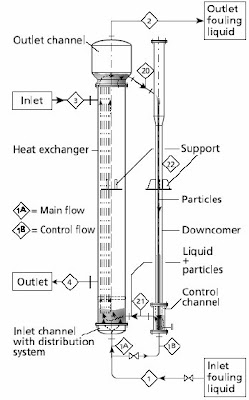
Operating Principle
The fouling liquid is fed upward through a vertical shell and tube exchanger that has specially designed inlet and outlet channels. Solid particles are also fed at the inlet where an internal flow distribution system provides a uniform distribution of the liquid and suspended particles throughout the internal surface of the bundle. The particles are carried by the upward flow of liquid through the tubes where they impart a mild scraping effect on the wall of the heat exchange tubes, thereby removing any deposit at an early stage of formation. These particles can be cut metal wire, glass or ceramic balls with diameters varying from 1 to 4 mm. At the top of the exchanger the particles disengage from the liquid in a widened outlet channel and are returned to the inlet channel through an external downcomer and are recirculated continuously.
More excellent article and application of Self Cleaning heat exchanger :
- Zero-Fouling’ Self-Cleaning Heat Exchanger
- Principle, Industrial Applications and Operating Installations...
- Developments and Achievements in Self-Cleaning Fluidized Bed Heat Exchangers
- Cost Savings of ‘Zero Fouling’ Crude Oil Preheaters
Labels: Fouling Factor, Heat Exchanger, Shell and Tube Heat Exchanger
Monday, July 28, 2008
Display problem ? Click HERE
Recommended :
Subscribe FREE - Processing Magazine
Heat Exchangers are a significant part of many industrial processes that involve energy exchange. Most of these heat exchangers become fouled with use. The United Engineering Foundation, which hosts a conference every three years on the fouling problem, estimates that the cost of heat exchanger fouling is 0.4 % of global Gross Domestic Product (UEF, 2001). This high cost has lead to frequent study of the fouling problem, including numerous books and conferences on the subject (Somerscales and Knudsen, 1981; Melo et al., 1988; Bott, 1995). Much of this work has focused on particular industries. Crude oil processing, dairy and food processing, and nuclear reactor cooling are all industries that have conducted a large amount of research aimed at understanding and mitigating fouling.
Subscribe FREE - Processing Magazine
Heat Exchangers are a significant part of many industrial processes that involve energy exchange. Most of these heat exchangers become fouled with use. The United Engineering Foundation, which hosts a conference every three years on the fouling problem, estimates that the cost of heat exchanger fouling is 0.4 % of global Gross Domestic Product (UEF, 2001). This high cost has lead to frequent study of the fouling problem, including numerous books and conferences on the subject (Somerscales and Knudsen, 1981; Melo et al., 1988; Bott, 1995). Much of this work has focused on particular industries. Crude oil processing, dairy and food processing, and nuclear reactor cooling are all industries that have conducted a large amount of research aimed at understanding and mitigating fouling.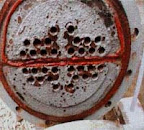
Particulate fouling of HVAC heat exchangers can lead to negative energy and indoor air quality impacts. This work investigated the mechanisms and consequences of particle deposition on fin-and-tube heat exchangers.
Jeffrey SiegelRead more...
Please constantly do heat exchanger maintenance to minimize OPEX.
Related Topics
- Heat Exchanger Fouling Mechanism, Prevention and Treatment...
- Why Lower Fouling factor in Plate Heat Exchanger ?
- Practical Design Tips for Heat Exchanger
- What type of heat exchanger can be used to handle fluid with solid ?
Labels: Heat Exchanger, Shell and Tube Heat Exchanger
Display problem ? Click HERE
"Plate Type Heat Exchangers V/s STHE - We are planning to replace an existing Shell & Tube HE with a Plate Type HE as the existing one is not offering the desired effect. The duty of the HE is attached. Since one of the fluid handled contains solids, can a PTHE handle it? I would like to know if similar retrofits have been carried out and what are the precautions to be taken while opting for such a change ? "First of all is to interpret "fluid handled contains solids" :
The process fluid contains solid can be
(a) high concentration, small particle size or;
(b) high concentration, large particle size or;
(c) low concentration, small particle size or;
(d) low concentration, large particle size
Above combination may end-up with different heat exchanger which best suit their own need. Thus, whenever specify solid in fluid, concentration (wt% or ppmw) and particle size (micron or mm) are required to be spelt out so that other (vendor , consultant) can provide the most cost effective solution whilst meeting process demands.
Can PHE take fluid with solid in it ?
PHE is having a very unique feature where narrow channel and proper engineered cross-sectional areas promote turbulence and high heat transfer (convective) capabilities. High turbulence has the potential of removing scale stick on the plate. However, present of solids in fluid promote pluggage in the narrow channel and ultimately results NO flow.
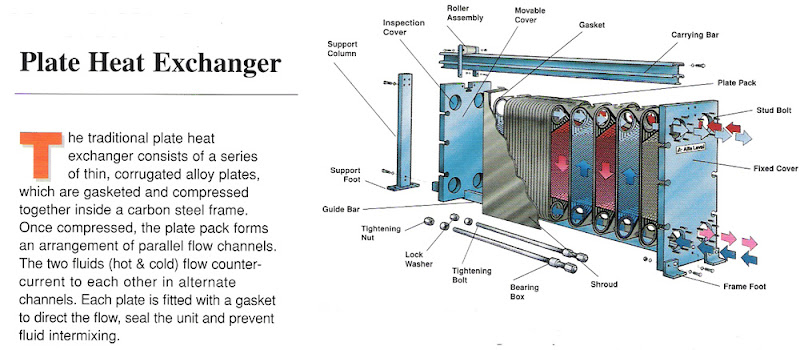
(Click image for better view)
What are the option can be suggested here ?
Probably first and ordinary option is relook into the root-cause of under-performed STHE by analyses the STHE construction, review maintenance frequency and methodology, etc and check if there is oppurtunity to modify existing STHE to increase heat exchange performance.
Somehow if it has to be replaced, there are some type of heat exchanger which properly suitable for "fluid contain solids". There are :
- Spiral HE (Alfa Laval , Sentry)
- Self-Cleaning HE (KLAREN)
- Heat Exchanger Fouling Mechanism, Prevention and Treatment...
- Why Lower Fouling factor in Plate Heat Exchanger ?
- Practical Design Tips for Heat Exchanger
- Typical Heat Transfer Coefficient For Air-Cooled Heat
- COLLECTION of Typical Overall Heat Transfer
- COLLECTION of Fouling Factor (FF) use in Heat Exchanger Design
Labels: Heat Exchanger, Plate Heat Exchanger
Thursday, June 12, 2008
Can't view properly ? Click HERE
Fouling in heat exchanger is one of most challenging operation problem. It is the buildup of sediments and debris on the surface area of a heat exchanger and reduce heat transfer.Fouling will reduce heat transfer, impede fluid flow and increase the pressure drop across the heat exchanger.
Plate heat exchanger as compare to Shell & Tube Heat Exchanger showed lower fouling factor. Have you ever thought of the reasoning behind ?
This article has briefly discussed types of fouling, fouling factor used in Shell and Tube Heat Exchangers for common fluids, why lower fouling factor in plate heat exchanger (PHE) and, design consideration to reduce effects of fouling....
Related Topics
Labels: Fouling Factor, Heat Exchanger
Tuesday, September 25, 2007
Can't view properly ? Click HERE

Heat exchanger sleeving, a money-saving technology generally associated with the electric power industry, is drawing increasing interest from engineers in the chemical process industries (CPI), as well.
Sleeving consists of expanding thin tubes (sleeves) into the tubes of a heat exchanger. The expanding process produces a residual, interfacial fit pressure between the outside surface of the sleeve and the inside surface of the tube. The sleeves may be short, for instance about 6 to 16 in., or may extend for the full straight length of the tubes. Typical sleeve thicknesses are 0.01 to 0.03 in., depending upon material of construction and thickness of the original tubes. In addition to the expansion step, sometimes the inner end of the sleeves is welded to the inside wall of the tube.
In tubular heat transfer equipment in power plants, sleeving has long been used for one or more of these purposes:
- To reduce the prospect of inlet-end tube erosion (short sleeves for this purpose are also called ferrules, and their use is called ferruling)
- To restore tubes to service that had been plugged by plant personnel because of known perforations in discrete, identifiable locations
- To restore tubes to service that had been plugged because their walls had become excessively thin
- To bridge failures in discrete locations of tubes that are otherwise intact; for example, if a tube has a circular crack just beyond the inner face of the tubesheet
Related Topics
Labels: Heat Exchanger, Life, Sleeving
Monday, September 24, 2007
Can't view properly ? Click HERE

 Heat Exchanger design is one of the common activities in plant design. However, although heat exchanger is designed in proper manner and follow most of the good engineering & design procedure, yet you might fails to achieve the desired performance by a wide margin. With an understanding of some common reasons why this might happen, designers can avoid these problems in the first place, and troubleshooters can recognize the root causes quickly.
Exchangers for single-phase operation, condensing and boiling are considered in that order here; but as we shall see, exchangers often handle a combination of these, and it is not always obvious which process is causing the problem. In fact, some of these problems are quite unexpected and can even take experienced designers by surprise. It must be recognized that the most important cause of problems in exchangers is excessive fouling. Other articles, books, and conferences have been dedicated to this problem, so fouling will not be addressed here. Instead we consider those exchangers that have failed for some reason other than fouling.
Related Topics
Labels: Design, Duty, Heat Exchanger, Tips
Monday, August 20, 2007

Basic heat transfer relationships is apply to Air-Cooled Heat Exchanger (ACHE). The fundamental heat ransfer equation :
Q = U. A. LMTD.F
where
U = overall heat transfer coefficientA = Heat transfer area
LMTD = Log mean temperature difference
F = Correction factor
Typical heat transfer coefficient for Air-Cooled Heat Exchangers
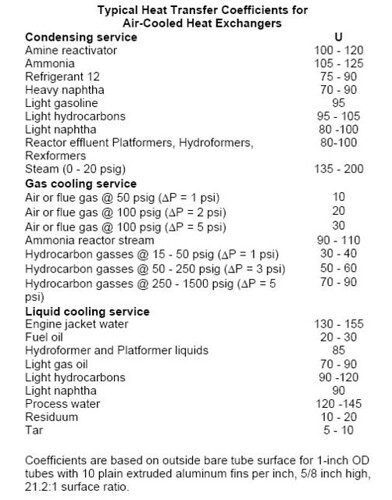
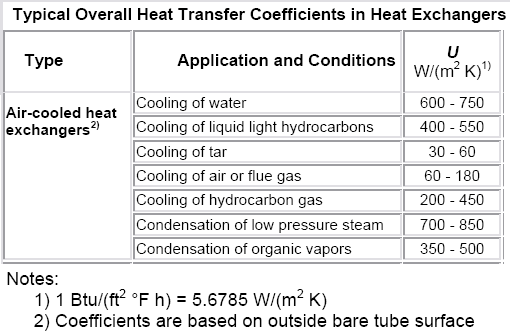
Source : DELTA T
Labels: Air Cooler, Heat Exchanger, Heat Transfer, Shell and Tube Heat Exchanger
Thursday, August 16, 2007
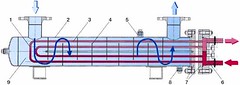
Fouling factor is generally used in the design to cater for heat exchanger deficiency resulted by fouling. TEMA has based on many years of experiences and experiments list out fouling factor for Shell & Tube Heat Exchanger for many services. Only TEMA subscribers are eligible to use this information. However, there are several reputable researchers & manufacturers have shared this information to the public. Following are the collection of fouling factors for different service.
- GEO-center (Plate Heat Exchanger)
- Control Around Heat Exchanger
- FAYF - Useful Heat Transfer Equation
- Few Tips on Energy Efficient & Recovery
- Heat Transfer - Internal and External Flow
- FREE E-book........A Heat Transfer Textbook
Labels: Fouling Factor, Heat Exchanger, Shell and Tube Heat Exchanger